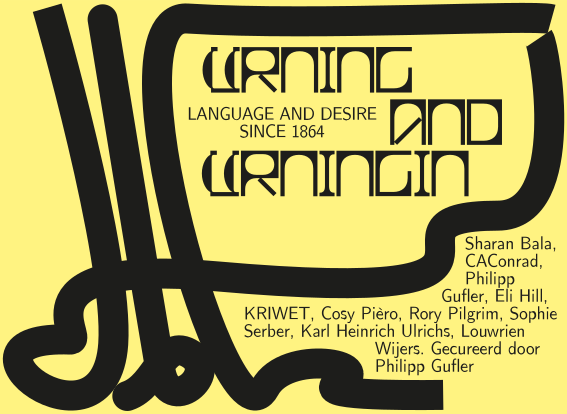
Urning & Urningin. Language and Desire since 1864
–Curated by Philipp Gufler

Note: this exhibition takes place in our renewed location at De Constant Rebecqueplein in The Hague.
- Sharan Bala
- CAConrad
- Philipp Gufler
- Eli Hill
- KRIWET
- Cosy Pièro
- Rory Pilgrim
- sophie serber
- Karl Heinrich Ulrichs
- Louwrien Wijers
- Philipp Gufler
Love and desire between people of the same sex have existed throughout history. For centuries, there was no language to name these desires–except in medical and legal terms that defined them as illness or crime. This began to change thanks to Karl Heinrich Ulrichs (1825–1895), a German lawyer who was the first to describe same-sex desire as an identity category. Ulrichs conducted extensive research into what he called ‘uranism’, built a network of scholars around it, and argued that queer desire should be recognised as something innate rather than criminal. With his own vocabulary for queer people, he articulated queer identity long before words such as homosexual, gay, or queer existed.
Ulrichs’ legacy forms the starting point for the exhibition Urning and Urningin. Language and Desire since 1864. The title refers to Ulrichs’ positive description for himself and others with queer desire: Urning and Urningin. He used these words publicly for the first time in his series of pamphlets Riddle of Male-Male Love, published between 1864 and 1880. Before that, queer desires were left unnamed and treated as equivalent to forbidden sodomy in Western society at the time. Ulrichs’ new words were widely used in German at the end of the 19th century and were also adopted in the Netherlands and beyond. Although his terminology did not stick in the current times, Ulrichs’ ideas laid the groundwork for modern queer theory.
In this exhibition, guest curator Philipp Gufler explores the limitations of language–then and now–in expressing desire, and calls for intersectional solidarity. Alongside original documents and letters by Ulrichs, which offer a glimpse into his era and the influence of his thinking, nine contemporary artists have been invited. Through their work, they reflect on themes of (gender)identity, language, and queer desire. Marking the 200th anniversary of Ulrichs’ birth, this exhibition connects past and present, showing how exchange across generations can be both hopeful and transformative.
A publication will be released alongside the exhibition, featuring a pamphlet by Karl Heinrich Ulrichs, visual material by the artists, and newly commissioned texts by Gürsoy Doğtaş, Hendrik Folkerts and Simon(e) van Saarloos



Find the exhibition magazine Nesting Habits #1 - Urning & Urningin. Language and Desire since 1864 here.
- Urning and Urningin. Language and Desire since 1864. press kitsDownload:Press P... (zip)
- Urning & Urningin. Language and Desire Since 1864 - documentation press kitsDownload:Press p... (zip)
- Gay Nieuws,Searching for the language of desire